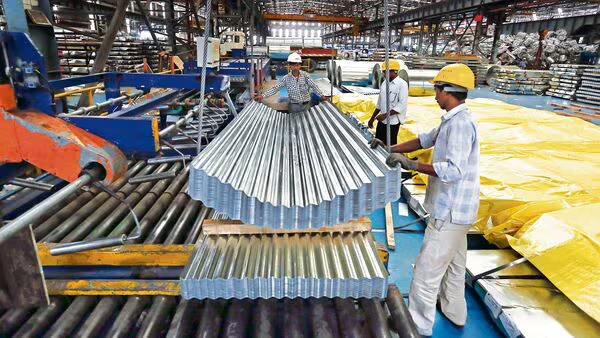
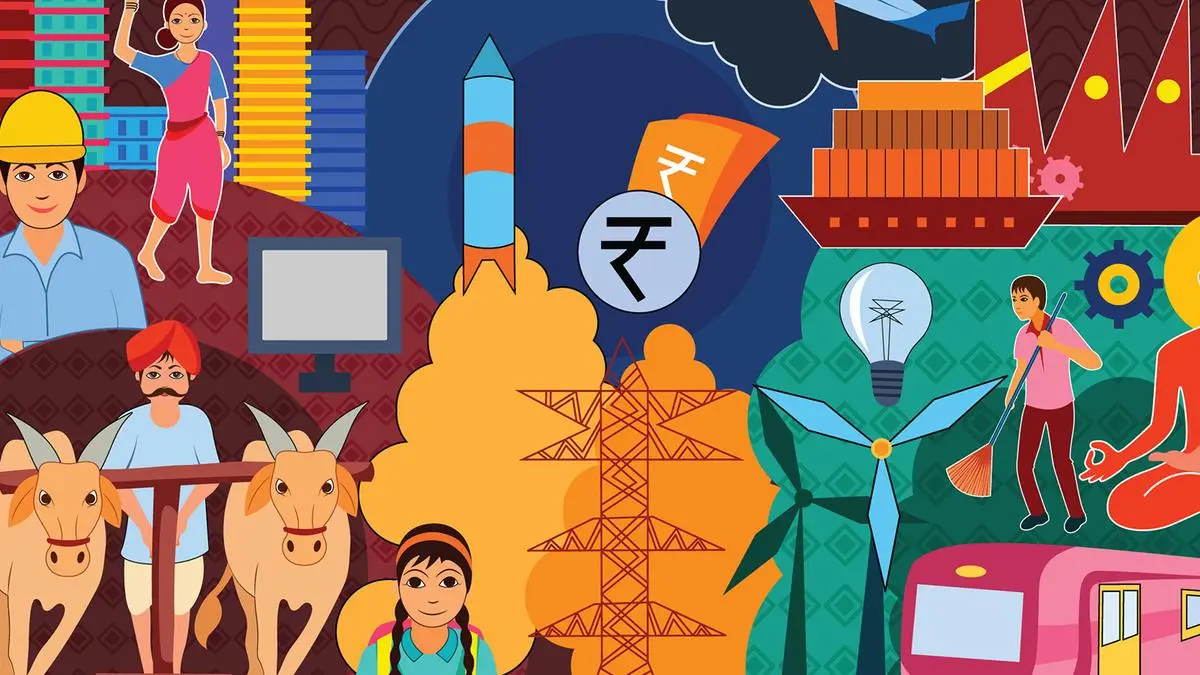
New scheme announcements and expansions of existing ones are likely for small and medium industries in general and for sectors like textiles, leather, footwear, gems, jewellery and handicraft, among others. The Centre is preparing to reinforce and expand its focus on labour-intensive industries in the FY-27 Union Budget, according to two persons familiar with ongoing discussions. This continues the thrust that began with sharply higher allocations last year to labour-facing industries, and the recent rollout of the four labour codes. Policy makers feel that India must deliberately strengthen labour-absorbing sectors—alongside sustained investments in education and health—to fully realise its demographic dividend over the next 25 years. The strategy will also seek to address a key problem India is facing—capital-intensive industrial growth struggling to create adequate jobs for India’s youth. Labour intensive sectors played a key role in the strong growth of countries like China, South Korea and, in more recent times, Vietnam.
The idea is to help create a base of strong mid-sized enterprises to support the country’s large informal sector comprising 73 million unincorporated, non-agricultural enterprises and some large corporations. “One of the structural issues to be addressed is the ‘missing middle’, so that we have more mid-sized businesses that can sustainably support economic growth and job creation,” this first person cited above said. “Once India reaches middle-income level for the next 10-15 years, we have to grow fast to avoid the middle-income trap.” Lower-middle-income economies are defined by the World Bank as having per capita incomes of $1,136-4,495; upper-middle-income economies extend to $13,935, and high-income beyond that. India’s per capita income stands at roughly $2,700. The ‘middle-income trap’ describes countries that plateau at middle-income levels and fail to advance to high-income status. Notably, only 669 firms (partnerships) and 4,357 companies with income in the ₹25-50 crore range have filed income tax returns in assessment year 2023-24, according to data available from the Central Board of Direct Taxes (CBDT). Queries sent to the Ministries of Finance and Labour, seeking comments for the story remained unanswered till press time.
More power to labour:
The Modi Administration’s emphasis on labour-intensive sectors became evident in the current year’s budget, when fund allocations were significantly increased for several industries. The Textiles Ministry saw allocations towards centrally sponsored schemes rise 69% year-on-year (y-o-y) to ₹4,659 crores this fiscal, as per budget estimates, to incentivise production of textiles and set up mega textile parks. The MSME Ministry received 34% higher allocation y-o-y (to ₹22,899 crores), and the Labour and Employment Ministry received a whopping 82% higher allocation y-o-y to ₹31,820.8 crores for central schemes. Likewise, the Health Ministry received 25% jump y-o-y from revised estimates for FY-25 to ₹7,797 crores. And in education, primary and higher education received 14% and 7% higher allocations, respectively, to ₹78,572 crores and ₹50,077 crores this fiscal. Then, last month, the Central Government notified four labour codes replacing 29 scattered laws with a new framework on wages, industrial relations, social security and occupational safety, health and working conditions. The codes offer universal social security for gig workers, mandatory appointment letters for all employees, and statutory minimum wages with timely payment across sectors, among other measures.
MSMEs need support:
Experts said there is a strong case for supporting small and medium businesses. Rumki Majumdar, Economist at Deloitte India, said that following demand-boosting measures from the Centre such as Income Tax and GST rates reductions, and with the Central Bank cutting the policy rate by 125 basis points, there is little room now to boost demand. “The Government will likely focus on supply-side measures,” Majumdar said. “These measures could be supporting MSMEs (micro, small and medium enterprises) and growth in priority sectors such as semiconductors, critical minerals, defence and electric mobility.” “There is also a need to broad-base economic growth. Building ecosystems for MSMEs in tier-I or tier-II cities and towns by enhancing access to physical, social, digital infrastructure, energy, credit, improving logistics and last-mile connectivity will be critical for MSMEs in India,” said Majumdar. Rishi Shah, Partner and Economic Advisory Services Leader at Grant Thornton Bharat pointed out that public spending on health and education has been treated as a social priority more than an economic one, when in fact these are the highest-return investments that can be made. “More efficient allocations toward primary healthcare, foundational learning, and skilling that are tightly linked to labour-market demand will not only raise participation rates but also reduce future fiscal pressures on welfare and public health systems,” said Shah.
Source : https://www.livemint.com/budget/after-labour-codes-rollout-centre-to-double-down-on-job-labour-intensive-sectors-fy27-union-budget-11765194630633.html