Hey, like this? Why not share it with a buddy?
S&P Global Ratings has shifted India’s economic forecast to a positive outlook from a stable one. The agency’s specialists have indicated that the country’s fiscal performance and economic expansion will be crucial determinants for a potential elevation in its credit rating over the forthcoming two-year period.
Andrew Wood, the director at S&P Global Ratings for sovereign and international public finance in the Asia-Pacific region, emphasized the significance of India’s rapid growth rate in the context of credit ratings, expressing increased confidence that the nation’s government debt is expected to stabilize and gradually decrease relative to its GDP, despite current high fiscal deficits.
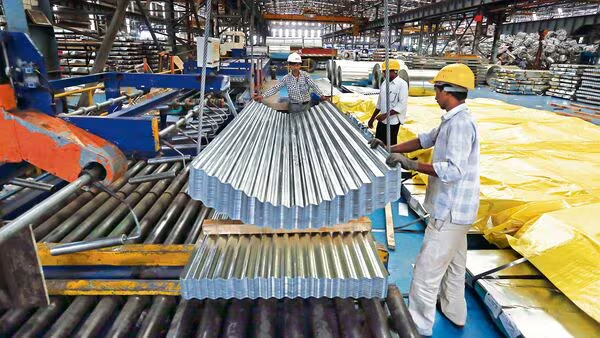
The analysts project that with enhanced infrastructure investments leading to better connectivity, India’s economy has the potential to expand by 8% in the long term. YeeFarn Phua, another director at the agency, suggested during a webinar that the growth rate could be even higher if not for existing infrastructure constraints.
India’s fiscal deficit and debt levels are notably higher than those of similar economies in the region, a factor that is taken into account in the credit rating process. India’s current credit rating stands at ‘BBB-’.
A significant reduction in fiscal deficits, leading to a net decrease in general government debt to less than 7% of GDP, is cited as a key condition for an upgrade in the rating.
The Indian government has set a target to reduce the fiscal deficit to 4.5% of GDP by the fiscal year 2026, down from the 5.1% projected for the current fiscal year. The agency anticipates the combined fiscal deficit of the central and state governments to contract to 6.8% by FY28, with the central government’s deficit reaching 4.2%.
Comparatively, Malaysia’s fiscal deficit is expected to be 4%, while Indonesia and Thailand project a 2-3% deficit, and Vietnam aims for a 3.5% deficit. Phua pointed out that an excess RBI dividend of nearly Rs 1 trillion could aid the Indian government in achieving a more favorable fiscal outcome, although such a dividend is not a recurring event.
Demographic advantages are also anticipated to contribute to India’s economic growth. Public investment and consumer spending are projected to be the primary drivers of this growth, with the agency expecting these factors to significantly boost real GDP growth. However, they also noted that the rise in private capital expenditure is likely to occur at a more measured pace.
Related Posts
SEARCH SME E-News
RECENT POST
Archives
- April 2026
- March 2026
- February 2026
- January 2026
- December 2025
- November 2025
- October 2025
- September 2025
- August 2025
- July 2025
- June 2025
- May 2025
- April 2025
- March 2025
- February 2025
- January 2025
- December 2024
- November 2024
- October 2024
- September 2024
- August 2024
- July 2024
- June 2024
- May 2024
- April 2024
Categories
- Achievements
- Banking & Finance
- Branding & Marketing
- Business Ethics & Culture
- Business talk
- Business Tycoons
- Capital Market
- Corporate Story
- Davos
- Economy
- Emerging Market
- Entrepreneurial Leadership Dialogue
- events
- Exports
- Grievances
- Growth
- Impact on Business
- Import
- India Growth Story
- Industry
- Innovation and Invention
- Innovative Ideas
- International Affairs
- International Trade
- jobs career
- Manufacturing
- Meeting
- MSME
- Others
- Packaging
- Pharma
- Policies & Schemes
- Regulatory Change
- Schemes
- Skill Development
- SME Talks
- Start-up
- Swot Analysis
- Tax
- Technology & Research
- Textiles
- Travel
- Uncategorized
- Viksit Bharat 2047- Strategies, Contribution, Initiatives and Efforts
- Women Entrepreneurs
- World Economic Forum